CodeXray API Security Observability – Architecture Overview
CodeXray delivers comprehensive visibility and protection across your entire API landscape. Built on a modern, cloud-native architecture, the platform continuously discovers, analyzes, and secures APIs in real-time while scaling seamlessly with your enterprise requirements.
This document provides a technical overview of CodeXray's layered architecture, illustrating how API telemetry flows from collection through to actionable security intelligence.
Architecture Visualization
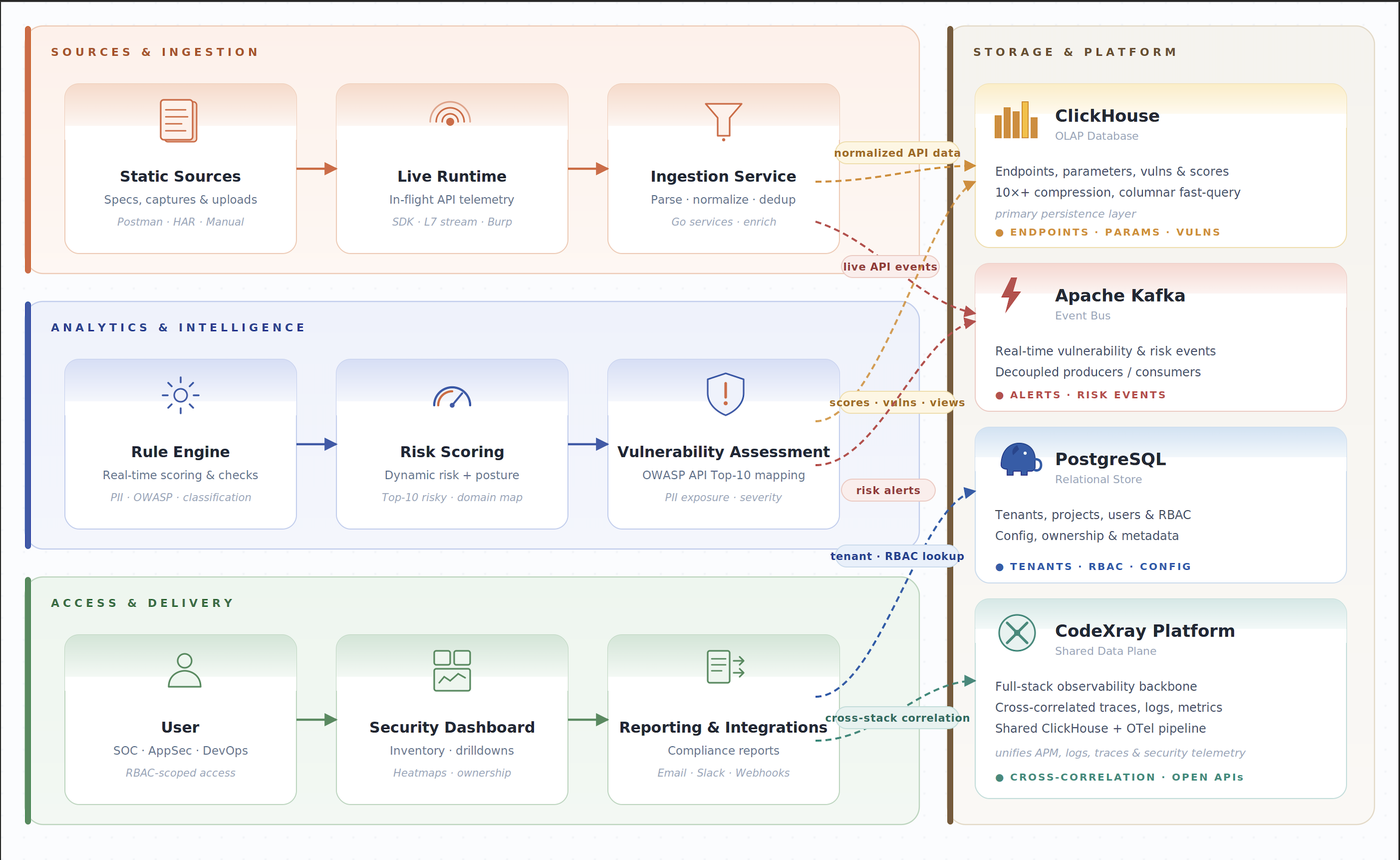
Click to expand the full architecture diagram
Architectural Layers
CodeXray's architecture is composed of six distinct layers, each designed to handle specific aspects of API security observability. Together, they form a complete pipeline from data ingestion to enterprise integration.
Layer 1: Data Collection
Objective: Establish comprehensive API visibility by capturing traffic from multiple sources.
The Data Collection Layer serves as the primary entry point for all API telemetry. It supports both static analysis of existing API definitions and dynamic runtime monitoring, ensuring complete coverage of known endpoints and shadow API discovery.
Collection Sources:
Static Analysis
- Postman collections and workspace imports
- HAR file uploads from browser sessions
Dynamic Runtime Monitoring
- SDK instrumentation*
- Layer 7 traffic streaming
- Burp Suite integration for security testing
Business Value: Achieve full API inventory visibility without blind spots. Discover shadow APIs and undocumented endpoints that traditional API gateways miss.
Pro Tip: Start with static collection methods for immediate inventory visibility, then progressively enable SDK instrumentation for real-time monitoring as you scale.
Layer 2: Ingestion & Processing
Objective: Transform raw API data into normalized, enriched, and classified security intelligence.
Built on high-performance Golang services, this layer handles large-scale API telemetry ingestion with minimal latency. The lightweight rule evaluation engine applies security policies in real-time, ensuring immediate risk detection.
Core Components:
Ingestion Services
- Multi-source data normalization
- High-concurrency processing pipeline
- Low memory footprint for efficient resource utilization
Rule Evaluation Engine
- Real-time risk scoring algorithms
- OWASP API Security Top 10 detection
- Personally Identifiable Information (PII) classification
- API exposure classification: Public, Internal, Partner
Technical Advantage: The Golang-based architecture delivers sub-second processing times even at enterprise scale, enabling real-time security posture assessment.
Implementation Note: The rule engine is extensible, allowing custom security policies to be added without performance degradation.
Layer 3: Data Persistence
Objective: Store high-cardinality API telemetry with optimal performance and storage efficiency.
CodeXray leverages ClickHouse, a columnar database optimized for analytical workloads, to store massive volumes of API metadata, parameters, vulnerabilities, and risk scores. This foundation enables rapid querying and long-term trend analysis.
Storage Architecture:
ClickHouse Database
- Endpoint metadata and request/response schemas
- Vulnerability findings and risk scores
- Historical trend data for compliance reporting
- Query performance: millisecond-level response times
- Storage efficiency: 10x+ compression ratios
Platform Integration
- Unified backend with CodeXray Full-Stack Observability
- Consolidated analytics across application and API layers
- Cross-correlation of security events
Operational Benefit: Retain months or years of API security data without infrastructure bloat, enabling historical analysis and compliance auditing.
Layer 4: Analytics & Intelligence
Objective: Transform raw data into prioritized, actionable security insights.
This layer applies advanced analytics to compute risk scores, identify vulnerability patterns, and generate intelligence that security teams can act on immediately. The output is contextualized, prioritized, and mapped to industry-standard security frameworks.
Intelligence Components:
Risk Scoring Engine
- Identifies Top 10 highest-risk APIs per domain
- Calculates organization-wide API security posture
- Trend analysis and anomaly detection
- Risk aggregation across business units
Vulnerability Assessment Engine
- PII exposure detection and classification
- OWASP API Security Top 10 mapping
- Severity categorization (Critical, High, Medium, Low)
- Remediation guidance with code-level recommendations
Decision Support: Security teams receive prioritized findings rather than overwhelming alert volumes, enabling focused remediation efforts on the highest-impact vulnerabilities.
Best Practice: Leverage risk scoring to drive sprint planning and security roadmap prioritization based on actual threat exposure.
Layer 5: Access & Presentation
Objective: Deliver role-specific security intelligence through intuitive interfaces and comprehensive reporting.
The presentation layer provides tailored views for developers, security engineers, and compliance auditors. Role-based access control ensures users see relevant information without overwhelming detail or unnecessary access.
User Interfaces:
Security Dashboard
- Role-based access control (RBAC) for Developers, Security, and Auditors
- Executive summary views with key risk indicators
- Detailed drilldown capabilities to individual API endpoints
- Timestamp-based investigation for incident analysis
- Contextual remediation guidance
Reporting & Export
- Compliance-ready reports (SOC 2, ISO 27001, PCI DSS)
- Customizable dashboards for different stakeholders
- Scheduled report generation and distribution
- Export formats: PDF, CSV, JSON
Stakeholder Value: Each team gets precisely the information they need in the format they prefer, from executive summaries to technical implementation details.
Layer 6: Integration & Platform Backbone
Objective: Provide flexible data ingestion methods to fit your workflow.
CodeXray currently supports three primary integration methods for API data collection, allowing teams to choose between automated runtime monitoring and manual analysis workflows.
Integration Methods:
Automated Collection
- SDK instrumentation for continuous runtime monitoring
- Automatic API discovery and telemetry capture
- Zero-configuration data transmission to CodeXray platform
Manual Upload Workflows
- HAR file upload through web interface
- Postman collection import
- On-demand security analysis
Platform Access: Access CodeXray's security dashboard through the web interface to view analysis results, risk scores, and vulnerability findings.
Integration Tip: Use SDK instrumentation for production environments to enable continuous monitoring, and supplement with manual HAR/Postman uploads for pre-production testing or ad-hoc security assessments.
Architecture Summary
| Layer | Primary Function | Key Technology | Business Outcome |
|---|---|---|---|
| Data Collection | Multi-source API traffic capture | SDK, Static imports, L7 streaming | Complete API inventory visibility |
| Ingestion & Processing | Normalize, classify, evaluate risk | Golang services, Rule engine | Real-time threat detection |
| Data Persistence | Store telemetry at scale | ClickHouse database | Long-term analytics and compliance |
| Analytics & Intelligence | Compute risk and generate insights | Scoring engines, ML models | Prioritized, actionable findings |
| Access & Presentation | Role-specific visibility | RBAC dashboards, Reports | Stakeholder-specific intelligence |
| Integration & Platform | Enterprise workflow connectivity | APIs, Webhooks, Notifications | Seamless security operations |
Design Principles
CodeXray's architecture embodies several core principles that drive its effectiveness in enterprise environments:
Scalability First: Built on cloud-native technologies that scale horizontally without performance degradation.
Real-Time Processing: Sub-second analysis enables immediate threat detection and response.
Storage Efficiency: Columnar database architecture reduces storage costs while maintaining query performance.
Open Integration: RESTful APIs and standard protocols ensure compatibility with existing enterprise tooling.
Role-Based Intelligence: Different stakeholders receive tailored views appropriate to their responsibilities.
Performance Characteristics
Understanding CodeXray's performance profile helps with capacity planning and deployment design:
- Ingestion Throughput: Processes thousands of API calls per second per node
- Query Latency: Dashboard queries typically complete in under 100ms
- Storage Compression: Achieves 10-15x compression on typical API telemetry
- Risk Evaluation: Real-time scoring with negligible processing overhead
- Data Retention: Supports multi-year retention without performance impact
Deployment Considerations
Cloud-Native Architecture: Deploy on AWS, Azure, GCP, or private cloud infrastructure.
High Availability: Multi-zone deployment with automatic failover capabilities.
Security Posture: End-to-end encryption, zero-trust networking, and SOC 2 Type II compliance.
Resource Requirements: Optimized for efficient resource utilization with predictable scaling characteristics.
Related Documentation
Explore additional resources to deepen your understanding of CodeXray capabilities:
- Data Collection & Ingestion – Detailed guide on API data collection methods and configuration
- Risk Analysis & Insights – Deep dive into risk scoring algorithms and vulnerability assessment
- Alerts & Policies – Configure custom security policies and notification workflows
Getting Started
Ready to implement CodeXray in your environment? Start with these steps:
- Assessment Phase: Review your current API inventory and security requirements
- Pilot Deployment: Begin with static collection methods on a subset of APIs
- Progressive Instrumentation: Roll out SDK instrumentation across applications
- Integration: Connect notification channels and enterprise workflows
- Scale: Expand coverage across all API domains and business units
Contact your CodeXray solutions architect for a customized deployment plan tailored to your organization's needs.